High-accuracy laser scanning captures existing environments with precision up to 0.025″ accuracy. Our field teams can typically scan 50,000–200,000 square feet in one to two days, depending on complexity.
Typical Deliverables:
Captured scan data is converted into structured digital models and drawings used by design teams and facility managers.
Typical Deliverables:
For factories and process environments, we convert scan data into engineering-ready 3D models used for planning and facility upgrades.
Typical Deliverables:
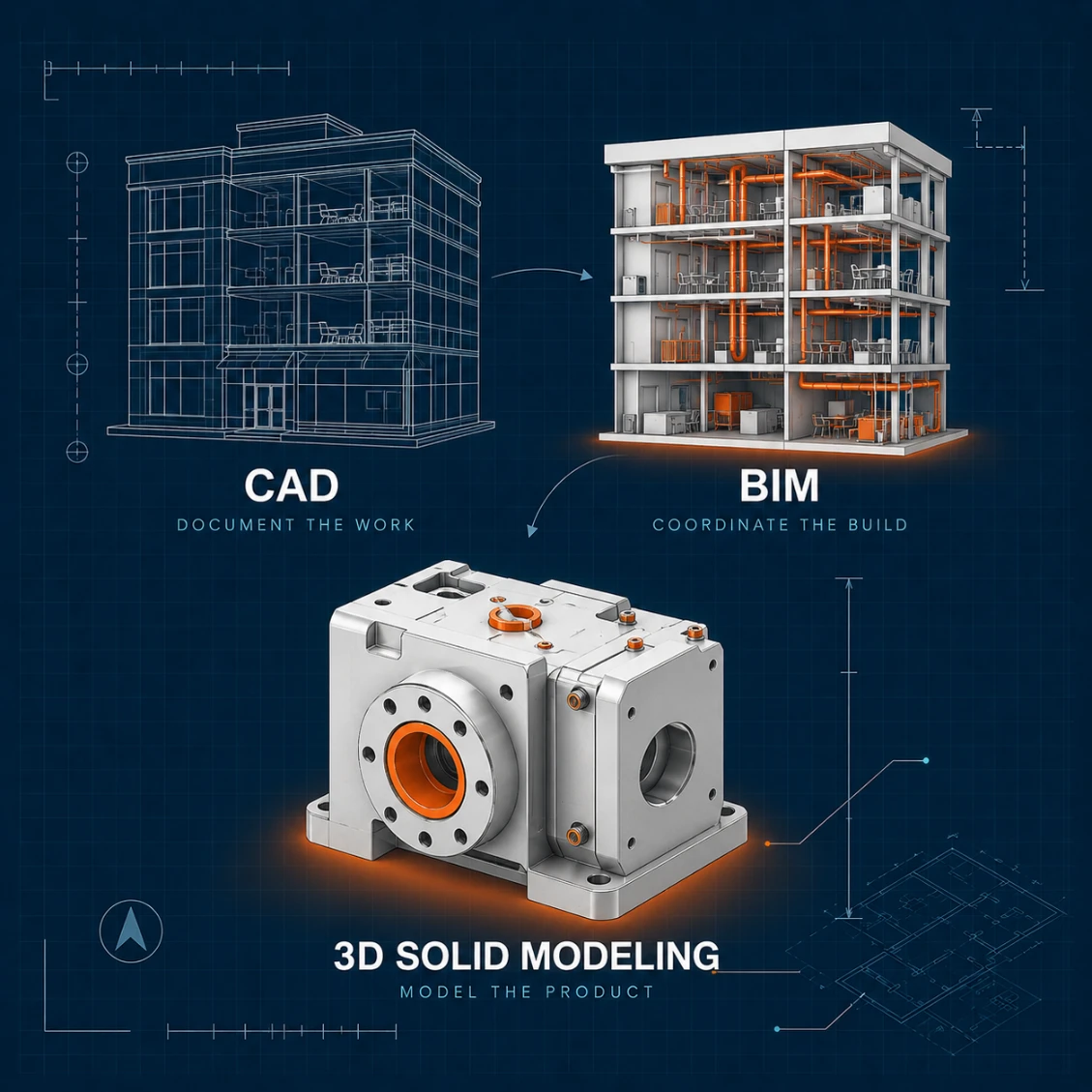
We offer nationwide 3D laser scanning, LiDAR capture, and point cloud generation — delivering precise digital representations of real-world spaces. Our Scan-to-BIM, Scan-to-CAD, and Scan-to-3D Solid Modeling services transform raw field data into actionable deliverables that support coordination, fabrication, and long-term facility management.
The Drafting Company is a trusted partner for LOD 200–500 BIM modeling, MEP coordination, and field-ready shop drawings. We support subcontractors across mechanical, electrical, and plumbing trades — helping navigate the virtual construction process with precision from coordination through fabrication.
We deliver schematic-level models capturing existing conditions for architects and engineers who need accurate baseline documentation without full construction detail — ideal for renovation planning and feasibility studies.
We deliver fully coordinated models with precise geometry, accurate sizing, and defined locations for all major building systems — giving design teams and contractors a reliable foundation for construction documentation, cost estimation, and early-stage coordination before fabrication begins.
We upgrade models to include precise interfaces between building systems, ensuring structural connections, MEP supports, and architectural elements are fully coordinated before construction begins.
We model elements with the fabrication detail needed to drive shop drawings and CNC manufacturing directly — what we model is exactly what gets built.
The ultimate facility management deliverable. We verify models against the physical build and embed operational data — including COBie-compliant maintenance and warranty information — for long-term asset intelligence.
Baseline models representing spatial relationships and existing geometry. Used for renovation planning, feasibility studies, and architectural documentation.
Detailed architectural modeling including walls, doors, windows, floors, ceilings, and major visible systems. Used by architects, contractors, and design teams as reliable documentation of the existing environment.
Field-verified models representing what actually exists at the time of scanning. These models serve as long-term digital documentation for facility owners and asset management systems.
Our architectural modeling typically includes
Additional equipment, manufacturing systems, or process piping can be modeled when included within the project scope.
Our team converts your scans or field measurements into industry-standard deliverables, tailored to your project requirements:
Field-accurate point cloud documentation of active facilities. Pre-construction baselines, mid-construction validation, and post-installation verification.
LOD 200–300 BIM models converted from scan data, documenting existing conditions for renovation, design, and facility management. Delivered in Revit and AutoCAD.
LOD 500 intelligent models with COBie asset data, lifecycle tracking, and FM platform integration. Built to serve your facility for its entire operational life.
Process piping models, equipment-level documentation, and facility-wide 3D scanning for industrial plants and manufacturing environments.
Accurate digital models start with accurate field data. TDC’s scan-first approach captures actual site conditions before modeling begins — ensuring every deliverable reflects what’s actually there.
Laser scanning documents the environment with high-accuracy point cloud data.
Our modeling teams convert scan data into structured CAD, BIM, or solid models.
Clients receive clear, structured digital documentation that can be used for renovation, planning, operations, or engineering analysis.
Our team converts your scans or field measurements into industry-standard deliverables, tailored to your project requirements:
Field-accurate point cloud documentation of active facilities. Pre-construction baselines, mid-construction validation, and post-installation verification.
LOD 300–400 coordination models built for clash detection, fabrication detailing, and field execution. Delivered in Revit, Navisworks, and Revizto.
LOD 500 intelligent models with COBie asset data, lifecycle tracking, and FM platform integration. Built to serve your facility for its entire operational life.
Process piping models, equipment-level documentation, and facility-wide 3D scanning for industrial plants and manufacturing environments.
In today’s fast-paced world of construction and redevelopment, relying on outdated resources like old PDF drawings, TIFF files, or fading paper plans exposes teams to costly surprises, delays, and rework. Traditional PDF-to-CAD or CAD-to-BIM conversions can only bridge part of the gap, often carrying forward the same inaccuracies that have existed in legacy documentation for years. As buildings evolve and systems are modified, these outdated files quickly lose relevance, creating disconnects between what’s on paper and what exists on-site. For owners, developers, and facility managers overseeing large, multi-building commercial portfolios, the solution lies in a more reliable, data-rich approach — Scan-to-BIM.
Our modeling teams document all major building systems from scan data. Here’s what we typically capture.
Large-scale facilities across multiple industries rely on TDC for accurate digital documentation
LOD 200–500 BIM modeling, scan-based documentation for renovations, and COBie-ready digital twins for hospitals where accuracy and operational continuity are non-negotiable.
Terminal scanning, LOD 200–300 BIM modeling, and lifecycle digital documentation for complex, multi-phase airport infrastructure.
Equipment-level scanning, process piping documentation, and digital twin development for manufacturing environments — delivered in SolidWorks, CATIA, Inventor, and Revit.
Full facility scanning, process piping modeling, and as-installed verification for plants where precision directly affects operational safety.
Scan-to-BIM conversion, structural as-built modeling, and lifecycle documentation for bridges, transit systems, and public infrastructure assets.
LOD 200–500 BIM modeling and scan-validated as-builts, and scan-validated as-builts for large-scale multi-family and assisted living developments.
We specialize in reality capture and model conversion — not theoretical BIM services.
Our teams are designed to process large facilities quickly and efficiently.
Mobile scanning teams can mobilize across the United States and internationally.
We model exactly what is requested within scope — no unnecessary complexity.
Phoenix, Arizona
Chicago, Illinois
Boston, Massachusetts
San Francisco, CA
Los Angeles, CA
Las Vegas, Nevada
Denver, Colorado
St Louis, Missouri
Omaha, Nebraska
Fargo, North Dakota
Minneapolis, Minnesota
Milwaukee, Wisconsin
Philadelphia, Pennsylvania
New York, New York
Nashville, Tennessee
Atlanta, Georgia
Orlando, Florado
Tampa, Florida
Miami, Florida
Dallas, Texas
Houston, Texas
Honolulu, Hawaii
We never model from guesswork. Every project begins with field-captured reality — ensuring your BIM reflects what’s actually there.
Single-source delivery across the full LOD spectrum. From early coordination to intelligent as-built — no scope gaps, no vendor handoffs.
Revit, Navisworks, SolidWorks, CATIA, Inventor, Creo — we operate natively across every major BIM and engineering platform.
Every deliverable goes through multi-stage QA before it reaches you. Field accuracy, model integrity, and data completeness — verified.